What happens on your phone when a document is revoked?
Institutions publish document status in a signed list. Your wallet checks it by itself, and the issuer never learns where you showed a document.
By: Tamga Wallet team7 min read
When an institution revokes a document, it changes that document's entry in a signed status list it publishes on the web. Your wallet downloads that list by itself while you are online, sees the change and marks the document Revoked; from then on the wallet will not present it, and any verifier that checks it rejects it. Nobody asks the institution about your particular document: wallets and verifiers download the whole list, so the institution never learns where or when you showed it.
Why does a document need a status at all?
A signed document stays mathematically valid until its expiry date, whatever happens in the meantime. Real life is less tidy. A student leaves the university, a ticket is refunded, an identity verification turns out to be wrong. The institution needs a way to say "this document no longer counts" without collecting every copy back.
The signature answers "who issued this, and has it been changed?". The status list answers a separate question: "does the issuer still stand behind it today?". A verifier needs both answers before it accepts a document (what a verifier checks).
What is a status list?
Tamga uses the IETF Token Status List format. The idea is simple: the institution keeps one long row of tiny boxes, and every document it issues gets one box. Each box holds a two-bit value.
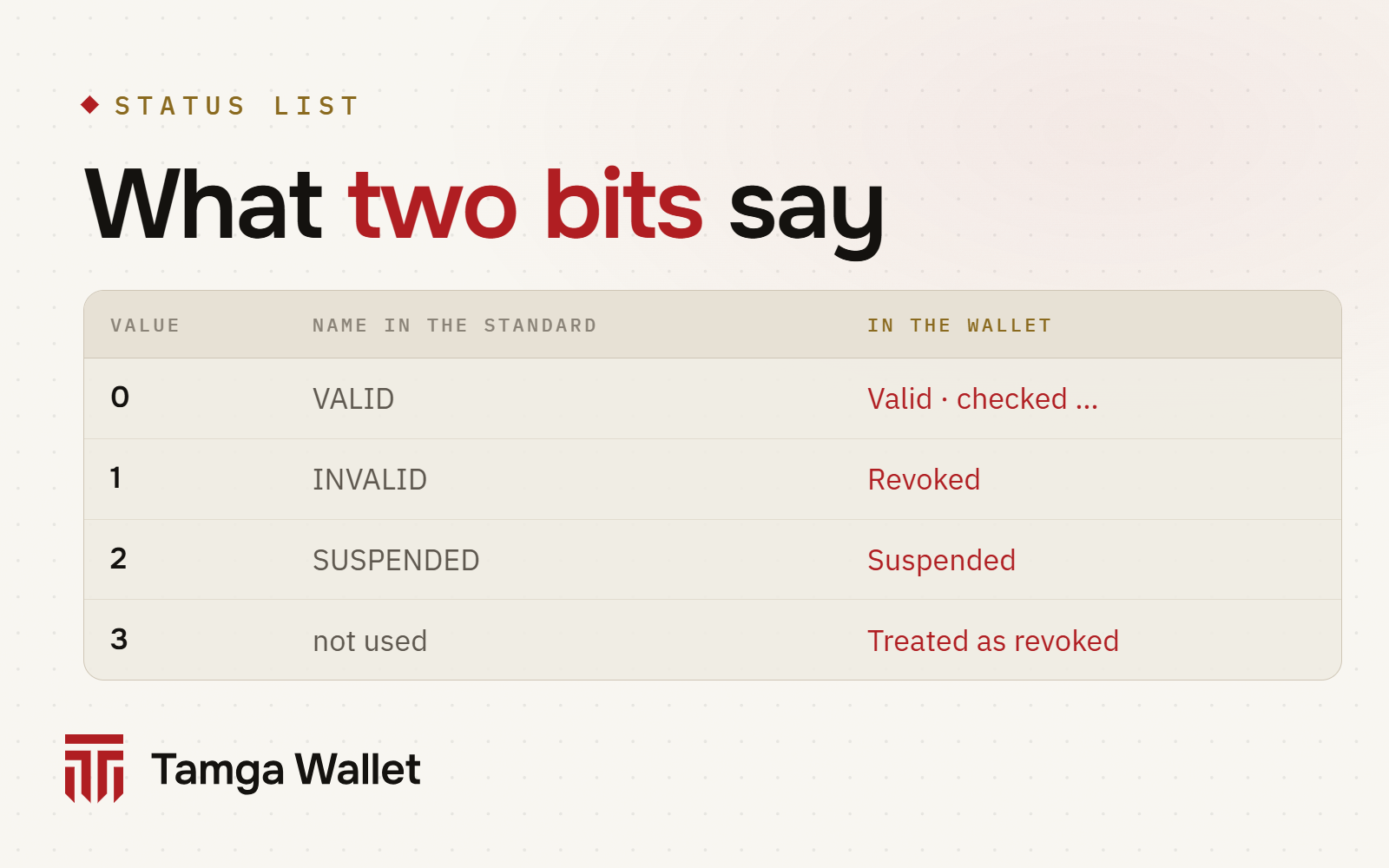
| Value | Name in the standard | What it means in Tamga |
|---|---|---|
| 0 | VALID | The document is valid. |
| 1 | INVALID | Revoked, permanently. It cannot be undone. |
| 2 | SUSPENDED | Suspended for now, and it can be lifted. |
| 3 | (not used) | Tamga does not use it; the wallet and verifiers treat it as revoked. |
Suspension exists for in-between cases. If an investigation is opened about a diploma, the institution may not want to revoke it for good before the outcome; it can suspend it and lift the suspension later.
The list is a signed token. Its signing key is separate from the key that signs the documents, and it must be the institution's status key registered in Tamga Network's trust list. The list is compressed, so even a list with 100,000 entries is a small file.
What stops the list itself from leaking information?
The document carries the list address and its own position in it, and both are visible to every verifier. So the network's rules make them meaningless on their own:
- Positions are random. A sequential counter would reveal that you were, say, the twelfth graduate on that list.
- Lists are large. At least 100,000 positions. A valid document and an unused position carry the same value, so nobody looking from outside can tell how many positions are taken.
- The address is opaque. A list address is a random string; it cannot contain a year, faculty or class.
- Each copy has its own position. Tamga Wallet holds several copies of a document so that different verifiers can't link you, and each copy has a separate random position. If any copy is revoked, the wallet treats the whole document as revoked.
How does your wallet check the status?
You don't need to do anything. When you open Tamga Wallet with an internet connection, it refreshes the status of your documents, at most once every six hours. For every list it downloads, it checks the signature, the address and that the signer is the issuer's registered status key. Then it reads the positions of your copies on the phone.
The result appears on the document page as a badge:
| Badge | Meaning |
|---|---|
| Valid · checked … | The institution has not revoked it; the time of the last check is shown. |
| Revoked | "The issuer has revoked this credential." It can no longer be presented. |
| Suspended | It cannot be presented while suspended; you get a "valid again" notification when that changes. |
| Not verified | The last check is more than 24 hours old or never happened, usually because there was no internet. You can still show the document. |
| Expired | The validity period has ended; it can no longer be presented. |
Revocations and suspensions also appear as notifications. Those notifications are created on your phone from the list it downloaded; no server sends them, so no server knows which documents you hold.
If a download fails, the wallet keeps the previous result. A document that was revoked does not look "valid" again just because the phone is offline.
Some documents never get a list. A student certificate, for example, is short-lived instead: it simply expires sooner. Its detail page shows "Status list: none (short-lived)".
Details of each badge: Credential status.
Why doesn't the institution learn where you showed the document?
This is the part that matters for privacy, and it comes from three rules in Tamga's status list profile.
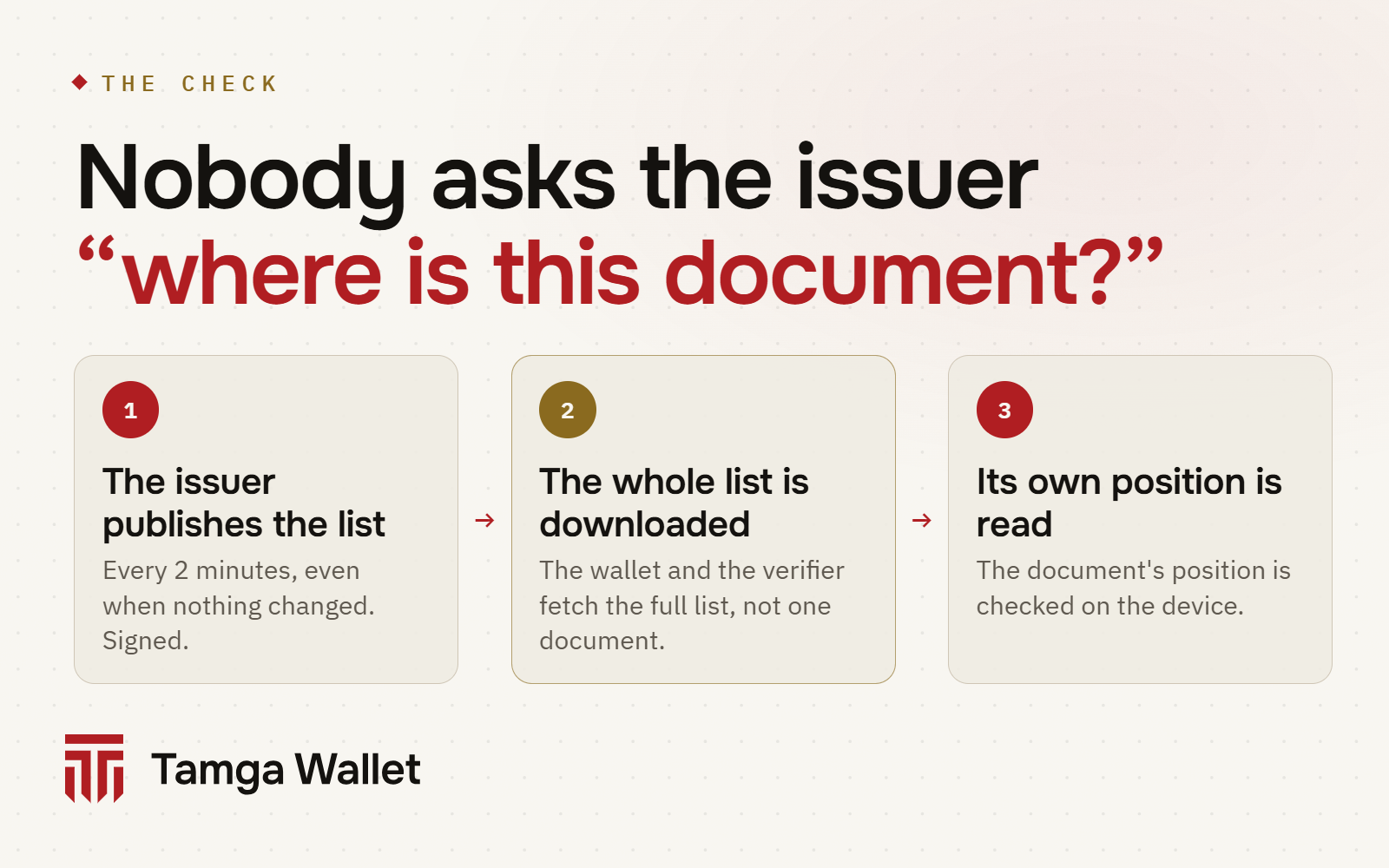
- The list is published on a fixed schedule. The institution republishes it every 2 minutes, even when nothing changed. From outside, a new version only means "two minutes passed", never "someone was revoked".
- Verifiers download lists in advance. A verifier fetches the lists it needs at regular intervals and keeps them in a cache. When you present a document, it looks up your position in its own copy; no request goes to the institution or to Tamga at that moment.
- Everyone gets the same file. Your wallet, a cinema's verifier and an employer all download the same complete list. Fetching it says nothing about which document someone is interested in. The standard calls this herd privacy: your document hides among all the others on the list.
Every publication of a list is also recorded in the network's anchor log. If an institution tried to quietly roll a list back, for example to make a revoked document look valid again, verifiers would notice the mismatch.
What if a verifier can't check the status?
Lists carry two time limits. A verifier fetches a list again after 2 minutes (ttl) and must stop using it 6 hours after it was published (exp), which covers a short outage of the status server. So while the server is up, a revocation reaches verifiers within a few minutes.
If the verifier cannot get a fresh enough list, the result is not "invalid". Tamga verifiers give a third result, indeterminate, and must show it differently: "cannot be verified right now, please try again shortly". The difference between "this diploma was revoked" and "I can't check right now" can decide whether someone is hired, so the two are never mixed up.
How is expiry different from revocation?
Expiry is written into the document itself when it is issued. Nobody needs to publish anything; the date simply passes. Revocation is a decision the institution takes later and publishes in the list.
The wallet warns you 30, 7 and 1 days before a document expires, in the app and, if you turn on phone notifications, while the app is closed; the lock screen shows no details. An expired document can no longer be presented, so you get a new one from the institution: Expiry and refreshing copies.
What happens to status if you lose your phone?
If your phone is lost, you close your wallet from any browser with your revocation code. The documents issued by the Tamga identity service (identity, driving licence information, email and phone) are then revoked through their status lists within 24 hours, and verifiers reject them. Documents from other institutions remain theirs to revoke, and on a new phone you get them again from the institutions. Step by step: What happens to your documents if you lose your phone?
Frequently asked questions
Does the institution know when I show my document?
No. Verifiers check status against lists they downloaded earlier, and the list is the same file for everyone. The institution sees only that its list is being downloaded.
Can I still show a document marked "Not verified"?
Yes. "Not verified" only means the wallet could not check recently, usually because there was no internet. Connect and tap Check now. The verifier makes its own status check anyway.
Can a revoked document become valid again?
A revoked document cannot; revocation in Tamga is permanent. A suspended one can: when the institution lifts the suspension, the badge returns to valid and you get a "valid again" notification.
Does a zero-knowledge age proof check revocation?
Not inside the proof, because revealing the list position would make proofs linkable. The network has decided that such a proof will use only short-lived copies of the identity document, valid for at most 24 hours and not renewed once the document is revoked; this is not in place yet. Until then each verifier's policy decides explicitly whether to accept such a proof; see Zero-knowledge proof.
Sources
Related
- Article · ConceptsWhat is a verified document, and why is it hard to fake?A verified document carries the institution's signature, is checked against a signed trust list and revocation list, and works only with your phone's key.
- Article · PrivacyShowing the same document twice: why the two can't be linkedTamga Wallet gives each verifier its own copy of a document and each site its own pseudonym, so two places can't match you by comparing notes.
- Article · GuidesWhat happens to your documents if you lose your phone?On a lost phone your documents stay encrypted and locked. Close the wallet with your revocation code, then get your documents again on a new phone.
- GuideCredential status: valid, revoked, suspended, not verifiedWhen online, the wallet itself checks whether the institution has revoked a credential; the badge shows the result and when it was last checked.
- GuideExpiry, notifications and refreshing copiesThe wallet warns you before a credential expires; when copies run low you get new ones from the institution.
Step-by-step help is in the Guide
Everything from setup to a lost phone, with the app’s own screens.
Get Tamga Wallet
On the App Store and Google Play. Carry your diploma, student card and tickets on your phone.